Thursday, February 21, 2008

Eagle and Condor Unite for Revolution and Freedom: Reports and Experiences from the Longest Walk II and DQ University

Eagle and Condor Unite for Revolution and Freedom:

Photobucket

Reports and Experiences from the Longest Walk II and DQ University

-Joaquin Cienfuegos

(Member of Cop Watch LA – GC and Revolutionary Autonomous Communities)

Note:

Brothers and Sisters asked to help spread the word and help spread the message and personal experiences of indigenous people from the South and the North participating in the Longest Walk and at DQ University. I’m sending out this correspondence in that spirit.

All power through the people.


This was sent out by the recently formed DQU Student Defense Committee

www.myspace.com/dquniversity

youtube video:

http://www.youtube.com/v/18jjkTK9Vxs&rel=1


February 20, 2008

DQU UPDATE !CHRIS, DAN AND MANUEL ARE ALL BACK AT DQU. There are many Native organizations, activists, advocates, supporters and Nationally known Indian Country leaders at DQU to welcome them back.

At 12:18 PST, Yolo County Sheriff's Department arrested three student leaders at DQ University. The students were served with an eviction notice and arrested under allegations of trespassing, at the request of the DQU Board of Regents. The students have occupied DQU since the close of the college in January 2005, working diligently with volunteers and supporters to secure accreditation and reopen DQU. DQ University is the ONLY Tribal University in the United States located off reservation lands.
Just one week ago, the Longest Walk 2 began its historic journey from DQ University, home of the Longest Walk. The Longest Walk 2 has pledged its support of DQU and the students there, recognizing the value and significance of Tribal Education and the history of DQ University.
Yolo County Sheriff's Dept. has informed us that all three are being booked, processed and will be cited with a notice to appear. They should be released later this afternoon.
"With this untimely event, we are now forming the DQU STUDENT DEFENSE COMMITTEE. We are seeking legal services from trained professionals and donations of money for qualified legal counsel. After hearing of this untimely event with these unwarranted and shocking allegations, this just shows the Indian world that the board of DQU is not interested in having any student body at DQU. This is a perfect example of why no one wants to work with this board. Four long years and no accreditation. Why ?" stated Quanah Parker Brightman.
For more information:
Chris Yazzie
530-554-8377 email yazzieyazzie@yahoo.com
Manuel
408-914-1079
Lupita Torres
408-529-3849 peetuhpocket@yahoo.com
Quanah Parker Brightman
510-672-7187 qbrightman75@hotmail.com

The students from DQ are asking for support and for people to go down there. Anyone is welcome, from teachers willing to teach to students willing to learn.

D-Q UNIVERSITY IS LOCATED ON COUNTRY ROAD 31, SEVERAL MILES WEST OF THE CITY OF DAVIS, AND 5 MILES EAST OF WINTERS, CALIFORNIA, IN RURAL YOLO COUNTY. DAVIS IS LOCATED 14 MILES WEST OF SACRAMENTO AND 72 MILES NORTH-EAST OF SAN FRANCISCO. THE SACRAMENTO METROPOLITAN AIRPORT IS APPROXIMATELY 30 MINUTES DRIVING DISTANCE FROM DAVIS.

Amber, who is a student at DQ was praying when 5 sheriffs came up to the students and told them they had 5 minutes to leave and started arresting people.

They arrested three students: Chris Yazzie (a Dineh brother), Manuel and Daniel who are Chicano.

“We’re out here and we’re fighting for the only tribal and Chicano university in California,” Amber told me.


DQ University: North and South Indigenous unity. The Eagle and the Condor Unite!


Interview with Caske a Lakota DQ University Student

JC: Can you explain the history of DQ for people?

Caske: DQ University was founded in 1971 by a group of Xicano students from UC Davis MECHA [Movimiento Estudiantil Chicana/o de Aztlan] and members from the American Indian Movement.

The Fort Laramie Treaty states: ‘Any surplus land that’s not being used by the american government will go back to the native peoples.’ Due to this treaty AIM [American Indian Movement] jumped the fence of an abandoned military communications base.

They proposed to establish a school for traditional cultural education. The occupation of Alcatraz by AIM happened before DQ University. DQ means Deganaweah (which comes from the Iroquois known as the peace keeper and his name can only be said in ceremony) and Quetzalcoatl. It symbolizes the unification of the natives from the North and the South. It also speaks to the prophecy of the 7th generation, which says that the 7th generation will rise up, unite the eagle and the condor, to fulfill the prophecy.

DQ was the central location for the original Longest Walk. Dennis Banks coordinated the walk from DQ.

JC: What is some of the recent history and events?

Caske: Three years ago people found out that the university’s Board of Trustees was embezzling money, filling out grand and financial aid and were keeping the money. The school lost accreditation due to the debt. For the past three years the university has been unaccredited but hasn’t ceased to be an educational base area. My grandfather Darryl Standing Elk does sweats at the university to bring that culture. There are also permaculture classes, drum classes, mural classes, and a different variety of classes and its been going on for the fourth year of us occupying and taking care of the land at DQ.

JC: Can you speak to people upholding native identity in the North and the South?

Caske: If you’re Brown and your people came from Turtle Island, than you’re indigenous to this land. They’ve created a wall, a border, just like they did in Berlin; to divide and weaken us. We are all native. Respect each other; see each other as brother and sister. We used to trade all up and down this continent.

JC: How can people connect with and support DQ?

Caske: People can support by going out to DQ and spend some time at the garden and the people there. There’s a diverse group of people with the same vision about how we should be living, as environmentally friendly as possible. We stress alternative energies, organic farming without using pesticides and poisons. We’re trying to get a program up and running on the internet so people can take on-line classes. So even if you’re 300 miles away you can learn.

We’re putting up all the board meetings up on YouTube because a lot of people don’t know what is going on at theses meetings. The outcome has been that the board ended up canceling the meetings; they assaulted a student and threatened to call the police.

JC: Are they the same members who stole the money?

Caske: They are relatives to them. The relatives are trying to cover up for their family. Five people were voted in by the students, but two members but two old members weren’t taken out of the board. They voted in people who had similar agendas as them. As of right now there only 6 members in the board, but there are supposed to be 16. There are supposed to be 9 federally recognized natives and 7 that are not federally recognized.

JC: Can you explain the significance and the importance of having a tribal college?

Caske: It’s important because it’s unique. It highly stresses culture and traditions. It has more hands-on learning experience and environment. It’s a place for healing. It’s a very sacred place. The name of the school itself was brought to the school by means of ceremony. They used to hold the AIM sundance at the DQ University back in the day.

JC: What is the role of a university like DQ in creating a revolutionary movement and getting rid of the system of colonialism, imperialism, capitalism, patriarchy and white supremacy?

Caske: It’s creating a prototype, a microcosm, of a better society. It’s giving a visual example of not polluting healthy life and eliminating diseases by eating healthy. A lot of native people suffer from diabetes and blood diseases; this could be ended just by eating healthier. We want to revert back to the structure of how indigenous societies used to work. For the most part they were ran by the elders, because they have lived a long life and seen things that youth haven’t. That makes them the only people with the ability to make responsible decisions.

JC: What do you think the role is for the youth in the movement?

Caske: The students are the workhorse, and the elder is the one that is guiding the horse, in terms of what needs to be improved in the community. Most problems occur when there’s miscommunication between the people, and that needs to be improved.


Interview with Phillip Mi-She-Kae (Turtle) a supporter of DQ and member of the Turtle Island Peacekeepers

“Compromise is what the predator always recommends, so we are Native not American, no matter who it offends.”

“I’m a member of Turtle Island Peacekeepers. Our purpose is to inspire solidarity between the Hood and Rez Natives. We might speak a language that is colonial, Spanish or English, but we’re native. It’s a slow process of Rez Natives accepting Mexicans and other Natives in the South. We feel that all sites are sacred. We also feel that self-defense is important. The 7th generation is not waiting around anymore. We’re an evolutionary warrior society. We’re going to stay small and stay focused. Cop Watch LA is part of this too because of the work that you do. All these people come to DQ, the Non-Profit Industrial Complex and Religious groups, they don’t come for ceremony, they come for money. We do music, activism, and ceremony. We believe that all camps have to come together and move. Eventually we’re going to sing the same song. We don’t come to put down our agendas, we come to learn. Half of us at DQ want a survival school: bows, running, story-telling. The other half want accreditation, they are weekend warriors, lets go away from this. After the Long Walk II left there were helicopters and Feds coming over to the school. In the crooked board there are two members who are BIA (Bureau of Indian Affairs). The BIA is the Indian version of the FBI, CIA, and cavalry. We carry the peacemakers prophecy, ‘D.’ He wasn’t Iroquois, he was Otchipwe. He had a vision of the white man going through the Six Nations. The Potowatomi (Keepers of the Fire), Otchipwe, Otawa are called the Three Fires – Anishnaabe Nation. Caske is Lakota, and our people’s used to war, by us rolling together we have broke through the division that the white man brought.

Cho-Qosh-Auh-Ho-Oh a Chumash Yaqui Elder Woman said, ‘The 11th hour isn’t coming, it’s already here, so we have to tend our gardens, we have to be good to our brothers and sisters.’”

JC: Can you speak to the importance of building alliances?

M: “We need to come together because the dark forces are coming together. The INFRA-Guard is a private intelligence surveillance agency. During Marshall Law they will kill anybody who resists. They are connected to Black Water (Bush’s private army). We can’t smoke the peace pipe with them until they strip themselves of their secret. All of them are our oppressors, the police are our oppressors.”

“An elder said, ‘Just as much light comes towards us, darkness comes towards us, but it’s not good or bad. In the balance that’s where the medicine is.’”

The Turtle Island Peace Keepers will be releasing a Benefit CD/DVD soon titled “They Bloodied Our Hands and Wounded Our Knees” with Savage Family, El Vuh, John Trudell, Annie Humphrey, Floyd “Red Crow” Westerman, Buggin Malone and others


Reports from the Longest Walk II the Northern Route

Interview with Mari Villaluna DQ Student and Media Coordinator of the Longest Walk II Northern Route -- “Urban Iroquois Indigena”


www.longestwalk.org
mari@poormagazine.org
(415)632-7279

JC: Please start with some of your experiences in the Longest Walk so far and why you decided to participate.

Mari: I’ve been working on this for one year. I was in DC when Morning Star the California State Coordinator told me about it. Some people say that Dennis Banks had been planning this walk since he participated in the 1994 Walk for Justice. I’m participating in the walk because of the Iroquois prophecy. We’re always supposed to think 7 Generations to the future and 7 Generations in the past. Everything I do is going to affect 7 generations in the future. The only religions not recognized in the U.S. are Native religions. Our sacred sites, and what we view as church is not honored. The Washoe here in Carson City view the Truckee River and Cave Rock as sacred places. Lake Tahoe is believed to be the center of the universe for the Washoe and it’s getting polluted. That’s their creation story and it’s being destroyed.

I really believe in the message of the walk: ‘All life is sacred, Protect Mother Earth.’

The times are scary. If we don’t protect this land, what is going to happen? My future generations won’t even have water to drink.

I wanted to learn from other indigenous nations, from their sacred sites. I wanted to learn from the people themselves, not a university or an ethnic studies textbook. I want to hear their stories, from them. I’ll learn to look at their lands differently; to protect land and our way of life.

Self-sacrifice is part of our religion. It draws us closer to Mother Earth and the Creator. Every step, in these five months, is a walk in that direction.

People have given me so much: jewelry, clothing, and other things, and I have also gifted them back with medicines and different things.

One of the main reasons why I’m participating is because of DQ University, is home of the Longest Walk. It’s the only university not on a reservation that connects both South and North Natives. The only one trying to fulfill the prophecy of the Eagle and the Condor Uniting.

JC: Can you explain the prophecy more?

Mari: The Americas, from Alaska to Argentina never had borders. The Mayas, Hopis (as we heard from a Hopi elder and veteran of Wounded Knee), and other indigenous people traveled everywhere. Some peoples were nomadic and others weren’t. I’m not saying we all got along, but we all considered indigenous people and learned from each other. We all need to get back to that.

I need to connect my struggle to the Zapatistas and other indigenous people in Mexico.

When I say ‘To all my relations,’ it means that I’m related to people in Mexico and people all over the Earth and even the air.

JC: Can you speak North and South Native people uniting in their common identity?

Mari: DQ has been the only time people North and South struggled for a common cause and identity. This year is important because the Peace and Dignity Run and the Longest Walk are happening at the same time. So that represents the Eagle and the Condor.

My mother is Tagalog (people from The Phillipines). Tagalog has over 250 words in Nahuatl (indigenous language of the Mexica). Nanay means mother in Nahuatl and Tatay means father and Tagalog people use it. This speaks to the interconnectedness of struggles. The Spanish brought indigenous slaves from Mexico when they colonized The Phillipines, and the Tagalog people and Mexican people found similarities in their struggle. I connect with people from the South. I have a Spanish last name but that’s not my experience. It also speaks to Pacific Islander and Native people mixing.

It’s about protecting Mother Earth and our culture in all its forms. There’s a guy here from Japan, and he believes in the same message. It’s the first time he’s met Native people but he believes in the same message but his is through Buddhism.


Two Native brothers from Los Angeles, Robert and Luv, explain their experiences in the Longest Walk. They’ve been helping with security and will participate in the entire five months. They are both doing it to get physical, mental, and spiritual training. These two brothers were in the frontlines of the South Central Farm encampment and are members/supporters of Revolutionary Autonomous Communities.

Robert: The walk has been great and inspirational. There has been youth 9 to 12 running as well. Raquel who is Miwok and 12 years old ran with us, as well as Vincent who about 8 years old. After everybody was tired and resting, he wanted to dance for us. He showed us some traditional Miwok dances.

Luv and Robert: In every community we’ve been in, both native and non-native, people just give so much to us.

Robert: The weather has been good to us. The weather gave us a window to cross the Sierras.

Luv: Its been a spiritual walk. We’ve had some obstacles, people in the road and Highway Patrol.

Luv and Robert: A brother from Guatemala who worked for Cal Trans helped us get the permit to run. It shows how different indigenous people have supported.

We’ve been eating well and we’ve participating in ceremony. It’s been a reconnection with nature. Yesterday we saw a hawk eating a rabbit in the middle of the road.

Luv: The hawk was a blessing. The hawk is a spirit guide and a totem to me. An older woman who has been helping me with the walk gave me four hawk feathers. Today I got my first Eagle feather from a Shoshone woman.

These two brothers want people from Los Angeles and other cities to support the walk, join it, and support DQ University.

Thursday, February 7, 2008

Los Angeles is the Heart of the Revolution

Los Angeles is the Heart of the Revolution
-Joaquin Cienfuegos

The city of lost angels and fallen stars
Stray bullets, highways and stolen cars

The ruthless police but the people are strong
Our fires and uprisings give our people hope and keep them warm.

The fire gets so hot it melts the plastic off of Hollywood
At times it might be tough, but if it came down to it we learn how to survive in the hood.

We are rebels.
From Watts, South Central, Compton, Pico Union, Inglewwod, East Los, Hollywood, Long Beach, Skid Row, and everywhere in between
The streets aren't paved with gold, and the problem for us is the Amerikkkan Dream.

The Reality is:
-Blood
-Empire
-Rape
-Genocide

You know the story, it hasn't changed
Only when we realize what time it is
We work on our aim and pump the 12 gage

We practice the art of warfare because it is being waged in our communities.

We know when to strategically retreat
LA is home to revolutionaries that never known defeat!

City of color, with struggle in our eyes and vision of freedom.
Turning our neo-colonies into liberated autonomous territories.

It's not the corporate media or the university,
But it's the streets that gives us the real story

We are peoples living, fighting, and surviving.
Running, loving, and dying.
Hiding, hustling and writing

We make history
And we change it with our fists
Politicians, pigs, sell-outs, gentrifiers, land-lords, developers, settlers, capitalists, poverty-pimps
We're creating our shit list

It will always be a land struggle
So, Black and Brown and all colonized people unite against the common enemy:
The State
This will always be Mexico and Indigenous land so tell the colonizer this isn't a debate

It's a revolution!

Perfect, like a clear sky in Los Angeles that lasts for a couple of hours after the rain.
Like an open shot, a molotov, a machete, a poem, a piece on an abandoned building
Destroying our mental and physical chains

The enemy knows the potential so they divide the Black and Brown
and Distract us with Hollywood Scandals
The Amerikkkan empire is the Belly of the Beast
But to the Left and to the Bottom is Los Angeles

Wednesday, January 30, 2008

Philadelphia: Dialogue with Member of the Revolutionary Autonomous Communities and Cop Watch LA - Sunday

www.lavazone.org

Photobucket

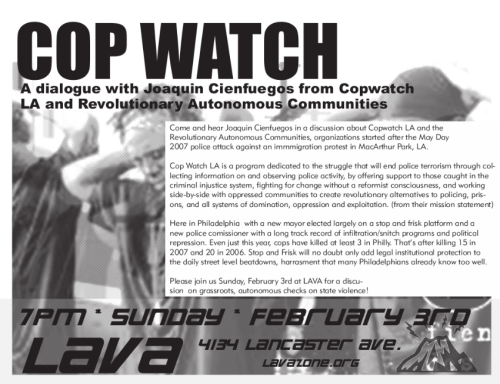
A dialogue with Joaquin Cienfuegos from Copwatch LA and RAC.

Come and hear Joaquin Cienfuegos in a discussion about Copwatch LA and the Revolutionary Autonomous Communities.

Cop Watch LA is a program dedicated to the struggle that will end police terrorism through collecting information on and observing police activity, by offering support to those caught in the criminal injustice system, fighting for change without a reformist consciousness, and working side-by-side with oppressed communities to create revolutionary alternatives to policing, prisons, and all systems of domination, oppression and exploitation. (from their mission statement)

Here in Philadelphia with a new mayor elected largely on a stop and frisk platform and a new police comissioner with a long track record of infiltration/snitch programs and political repression. Even just this year, cops have killed at least 3 in Philly. That’s after killing 15 in
2007 and 20 in 2006. Stop and Frisk will no doubt only add legal institutional protection to the daily street level beatdowns, harrasment that many Philadelphians already know too well.

Please join us Sunday, February 3rd at LAVA for a discussion on some grassroots, autonomous checks on state violence!

Revolutionary Autonomous Communities

Who we are. What we believe. What we fight for.

We are a revolutionary federation of community councils and liberated
spaces based in occupied communities made up of oppressed people of
color. We are a horizontal organization building self-sustainability
and creating the structure, strategy, and program for change through
direct participatory forms of organizing and a decision-making process
based on consensus. We stand against all forms of oppression:
imperialism, capitalism, white supremacy, patriarchy, fascism,
heterosexism and the domination of human over
human & human over all living things including mother earth. We
believe and we fight for autonomy, self determination, self
organization and the self defense of our communities.

Our strategy for Decolonization, Land and Liberty includes outreach,
popular and political education, direct action, community programs,
empowerment, support, , physical training and mutual aid, so people
can build self reliance and gain the skills, resources and the
experience to liberate themselves. In striving for freedom, we work to
decolonize our minds by embracing our indigenous roots and practices.
We fight for land! "Peace without land and liberty is not Peace."

Revolution comes from the people not a vanguard party; it is an
individual and collective process where we destroy the system while we
create change within ourselves and the world. The best way to show our
solidarity to the people of the world is to bring the war home, and to
bring down amerikkkan imperialism while we struggle to build
internationalism and intercommunalism.

We fight for freedom and won't settle for less!

ALL POWER THROUGH THE PEOPLE!!!!!!

rac@riseup.net

We're the Guerrila Chapter of Cop Watch Los Angeles.

We're made up of individuals from different hoods, looking to build a base in our own communities while we help create a mass movement to stop police terrorism against our peoples.

We are called the Guerrilla Chapter:
-We have full unity with the mission of Cop Watch LA
-We carry out the work of Cop Watch LA as a tactic
-We connect what we're doing to other social justice organizations we have unity with
-We build alliances
-We support families who are victims of the police
-We want to create a culture of direct action against he police state
-We hope that people can take up this movement and tactic on their own
-We want to inspire people to defend themselves
-We do Know Your Rights trainings
-We fundraise for our community programs and our communities
-We are grassroots
-We are all working class people of color from the hood
-We train and build the level of combativity in ourselves and our peoples
-We want self-determination and the self-organization of our neo-colonies
-We change ourselves in the process of changing the conditions in our communities
-We study, and we promote popular and political education
-We are members of the Revolutionary Autonomous Communities

The Guerrilla Chapter of Cop Watch LA feels it is important to not only discuss the problems that our communities are facing but to actively challenge them and change them. We exist for that purpose, while we build up our autonomous communities it is important to also connect these ideas to others and to build the fighting capacity of the people. The Guerrilla Chapter supports other communities who want to do the same type of work, we can provide whatever resources we have, the basic training and support for people to resist and build. We have believe in the principles of mutual aid and that one of our best defenses is our solidarity with others. We are not a vanguar party organization, we will not impose ourselves on communities, we have much more to learn from the people than we have to teach. Overall our purpose is to fight for land and liberty. We want freedom!

All power through the people!

LAVA 4134 Lancaster Ave. Philadelphia, PA 19104 phone: 215.387.6155 * info{at}lavazone.org

Wednesday, January 23, 2008

Article in the LA Citybeat about the Southern California Anarchist Conference 2007

LA City Beat Article on the Southern California Anarchist Conference: Miracle on 61st Street

Miracle on 61st Street
Fear and Exhilaration at the Southern California Anarchist Conference

~ By RON GARMON ~

The Library for Social Sciences and Research sits just into the Sixties on South Vermont, an area few would cite in defense of President Bush's "Ownership Society." A speck of mural-rusty cheer in a uniformly bleak urban landscape, the library took on an additional layer of gaudiness last weekend, as more than 200 mostly young activists filed in for the Southern California Anarchist Conference. It was a rare taste of both unscripted politics and revolutionary affirmation.

Sponsored by several local groups, including Anarchist Black Cross, the AK Press, and the South Central branch of CopWatch L.A., the event was capped Sunday, December 16, with punk rock and polemics staged by Apex Union at Centro se Accion Popular across town in Taylor Junction. AU's Rafael Camacho, a non-anarchist who promotes movement-related music events, described the conference as having little central planning outside of asking fellow SoCal radicals what they wanted to talk about and constructing a program around that.

The result was not your father's left-wing protest gathering, not that ghosts from movements past didn't rattle a bone or two. Wan, middle-aged missionaries from oldtimey splinter parties like the Spartacists stood outside seeking to engage passersby with Cold War-era micro-Leninism. The kids swarming in and out gave even less attention to such three-card monte dialectics than I, an ex-sectarian who could've given these sadsacks pointers on technique. Such top-down midget totalitarianism is, to them, part of the problem.

Anarchy, in practice and theory, is the new mode and ideal among an increasingly radical chunk of young America. This impulse will likely grow stronger once the consequences of the most recent economic crash make themselves felt. Frank, a comrade from the Central Valley, spied my tape recorder just after I brought it out and insisted on being interviewed. He stood behind two tables of eccentric homemade leaflets skirted by a banner reading, "Cook cops not meth, rob banks not each other." Like most politicians jumping at microphones, Frank cared little for answering questions. "We're out here at the conference supporting working-class self-organization and direct action against various systems of domination that exist in society," he said forcefully. Why Modesto? I asked. "There's a great deal of poverty out there and poverty leads to crime." Frank's face tensed a bit, like a Fight Club hardcase. "Just like everywhere else."

Most others around me seemed intent on materializing an unsupervised society in miniature. Small multiracial groups of close-huddled youngsters sat outside verbally groping toward ways of talking, realizing their own part in a cooperative commonwealth. All was that special fun-with-a-purpose sense of good cheer that always surrounds youthful activism. Passengers on MTA buses hurtling past glared in hostile disbelief at the harmony and goodwill vibes flowing out of the building into a street little used to it.

Friday afternoon, many stopped to hear Comrade Lala of the Black Riders Liberation Party lead a floor debate on revolutionary violence. The BLRP, Black Panther-inspired militants active in South Central and Watts since the mid-1990s, is the target of a gang injunction, with three of its leadership being held downtown on undisclosed "weapons conspiracy" charges. One might expect agitprop defiance, but the lovely comrade instead outlined the traditional closely reasoned Panther case for neighborhood self-defense against the police in soft and honeyed tones. Finally, one brother from the floor asked, "Who's up there with King and Gandhi who ever used violence?" Others of his herbivorous kind spoke against violence in the home and streets as manifestations of a system itself based on violence and repression. Still more demanded to know what right was ever wrested by force and the matter was tabled without rancor.

Practical matters of organizing affinity groups (proven effective in staging street action during the '99 WTO protests in Seattle) and revolutionary self-defense were taken up in later sessions. The latter was well-handled by Sensei Santo, a squat, heavily inked fighter who demonstrated various self-defense methods for breaking chokeholds, pulling arms from sockets, and disabling larger attackers. Friday ended with two original Black Panthers joining an animal-rights activist and an Internet anarchist to regale the young 'uns with tales of their stints as political prisoners.

Late for the Saturday session, I was legging down South Vermont when an LAPD patrol car blocked the curb in front of me and two smiling officers emerged with news that I was, in fact, in South Central and could be very easily murdered. Since cops in my downtown 'hood regularly make the same helpful confession, I was little troubled, but thanked them for their trouble. In the main room, a brother was inaudibly droning some kind of historical lecture over a lunchroom din as conferees tucked into free vegetarian eats. Images of Bakhtin and Lucy Parsons Gonzales (widow of Haymarket anarchist Albert Parsons) flickered mysteriously on a nearby screen and I got the idea the latter was being posthumously heckled for insufficient feminism.

There followed talks on whites organizing resistance to white supremacist groups like the Minutemen and Know Your Rights training from CopWatch. In the main room, some old-school Panthers were staging a reunion, with gimlet-eyed badasses like Ronald Elder Freeman prophesying in bone-yard terms of a political near-future of post-capitalist disaster, imperial reaction, and the likely martyrdom of many there. The collegiates and street kids alike looked awed, delighted even.

Hours later at an underground party far away, I unexpectedly encountered a pretty conference attendee, looking quite out-of-context in panties and fox ears. "That guy I was with thought you was a narc!" she giggled. I suggested she tell her boyfriend to stop acting like he's in jail already and went back to packing some excellent sativa. I had to spark up where the security guard couldn't see.

Proposal for National/Inter-Regional Anarchist People of Color Conference and Gathering

A couple of individuals from New York, Philadelphia and Los Angeles met informally and wanted to propose a national/inter- regional gathering for Anarchist People of Color.

This is just a draft proposal, it is not the final say in how this shit is going to happen or what's going to happen at it.

This is being put out to initiate some discussion around this idea.

This conference will be a serious gathering to strategize, dialogue, plan, follow through, and create the foundation for real solidarity and revolutionary movement throughout different regions.

Nothing has been set for the conference so that is why I'm putting this out there to people. There are some initial ideas that need to be built on.

The conference will be taking place in the summer or sometime in the fall, but needs to happen as soon as we can pull it together.

It is a crucial time in history and their is important organizing we are all doing and need to be doing. We need to support each other in our work and help each other strategize. Hopefully this can be the first step to building the foundation for a revolutionary movement.

Among the topics that are proposed:
-Building Black and Brown Unity!!! The work that we need to be doing, the responsibility that we have to do this. We must go beyond just talking about it. This is a key question in building unity amongst all colonized people.
-National Liberation -- Our position in supporting National Liberation in the process of creating autonomy and self-determination of colonized people
-Class Struggle within APOC -- who is APOC and why we have nothing in common with sell-outs
-Political Prisoners, our role as anarchist people of color in this movement.
-Follow through from the first APOC conference
-Popular Education and other strategies for organizing in our communities
-EZLN and Magonismo: other movements in Latin America and the third world
-Creating New models of organizing
-Indigenismo and anarcha-indigenism
-Our experiences as anarchist people of color and supporting each other, having solidarity and building
-The intersection of gender and sexuality to race and class
-Building APOC as a revolutionary movement

others... etc (these are all still proposals)

We want to get a good core group of committed people who want to help make this happen discuss this seriously to make it happen.

There were proposals for cities/states/ regions: Los Angeles, Minnesota, Colorado

The city/collective in the city will have to help coordinate space, housing, food, etc.

Each city will have to do some fundraising to send people and for general funds. Hopefully we can also raise money to help other cities with limited resources.

Lets discuss this seriously, and make this happen.

Friday, December 14, 2007

Statement for the KPFK Local Station Board

Joaquin Cienfuegos
STATEMENT
KPFK is a station that should be collectively owned by the people, the question is: Is KPFK that?
I am running for the KPFK Local Station Board, because this is a vital resource in the movement we seek to build and create. Imagine, a station where people of the community have a voice, where their struggles are not ignored, and where they themselves are helping run and maintain.
KPFK can be a radio station where new people are being trained on how to run their own shows, how to produce, how to interview, how to record, and how to work the board. People should be broadcasting from the frontlines of their local battles and struggles against oppression and injustice. There should be broadcasts in multiple languages, not just English, like Korean, Toga lag, Mandarin, Spanish and so on. We need to have more shows that are youth initiated, for and by young people and working class people of color. The issues of today and the issues of the oppressed should be priority on the station on the issues that are only important to a small minority of progressive privileged middle class white people. KPFK needs to become a station that everyone from the oppressed communities needs to listen to and begin to trust, but they can’t do that if they can’t relate to the station, what is on the air, and what politics it’s promoting. Issues and conflict of the station should also be made transparent to the listeners who support the station; otherwise it would by lying to the people.
The station needs to represent the vision of a better world. It has to give leadership to those who do not have a voice in this society. It needs to shine the light on oppression and injustice. If the station claims to be that, then it has to struggle against oppression and injustice even within the station itself. I hope to help with this vision and hope the help shift the paradigm at the station being part of the Local Station Board of KPFK.
My name is Joaquin Cienfuegos, I’m a member of Cop Watch Los Angeles (South Central Chapter) and the Revolutionary Autonomous Communities. I’m a 24 year old Indigenous-Chicano male from South Central Los Angeles. My parents are from Michoacan, Mexico, and immigrated here when they were both young. I started organizing when I was young, at 17 years old. What politicized me was my life experiences, dealing with the police in South Central, and the racist anti-immigration laws that were passed when I was young, especially proposition 187. I read a lot on my own, when I was kicked out of school for standing up to my teachers. I took my GED test and starting going to community college.
I began to focus on community organizing, because I felt the most potential was in empowering the people, and building the institutions that will replace the oppressive power structure, capitalism, imperialism, colonialism, patriarchy and white supremacy. People have power, they just need to realize it. So I began organizing and help create the Southern California Anarchist Federation – Los Angeles Chapter. We build Cop Watch LA out of that and with the help of a coalition called STOP (Stop Terrorism and Oppression by the Police) which was created after the police murder of Suzie Lopez Pena. Cop Watch LA was then created and branched out into the different communities that we lived in: South Central, Boyle Heights, Long Beach, Downtown, and so on. It was a tactic in the self-defense of our communities to combat police terrorism by observing the police with cameras and taking direct action.
The same working class youth of color help form the Revolutionary Autonomous Communities which is a revolutionary federation of community councils helping build a grassroots popular movement, build the autonomy, self-determination, self-organization, and infrastructure for self-defense of oppressed people and oppressed communities.
Thank you, Joaquin Cienfuegos Email me at: morph3030@yahoo.com

Monday, December 10, 2007

KPFK Local Station Board Candidates

by way of Leslie Radford at radiojustice.net ...
#1 Kahllid Al-Alim
Here's a brave man who's spoken against racism across the country and experienced first-hand the racism of a police beating. At his trial, the community came to his rescue with dozens of letters attesting to his importance in their lives and by their overwhelming presence in the courtroom. He's an organizer and leader of the student-parent-educator Coalition for Educational Justice, fighting for better classroom conditions in urban core schools and against military recruitment in the schools.

And he's a charmer, but he's outcharmed by his two young children. He's new to KPFK, but it's obvious after just a couple of conversations that he understands the turf and is ready to take it on. If you agree with me that progressive people with strong community ties should serve on KPFK's Local Station Board, then you'll rank Kahllid among your top candidates.

#2 Joaquin Cienfuegos
If I were to pick one candidate who meets all the criteria I've set out for the Local Station Board, it would be Joaquín. He's new to KPFK, only attended a couple of board meetings, checked it out, and decided the station had real potential for the communities of Los Angeles.
You're more likely to know Joaquin through his observations from Atenco, Mexico City, and Toluca on the anarchist and Zapatista movements, or maybe you know him as the co-founder of Cop Watch LA, the group that surveils the LAPD when the cops stalk the ghetto and the barrio and helped organize the civil suit against the May 1 LAPD invasion in MacArthur Park. Cop Watch LA has sprung up in just a little over a year, and it already has the LAPD on notice.
Joaquín is careful. He's careful about what he gets involved in, he's careful about who he supports. No phoney smiles and handshakes, but, if you prove yourself a friend or ally, you can be sure that he will have your back. And if Joaquín makes the commitment, he will give it everything he's got, and that will be enough.
#3 Schyna Pour
Serious, determined, a KPFK volunteer, and a listener for most of her life, Schyna brings her quiet, intelligent, deliberative attitude to KPFK. She's a young woman, but she's one of those young women who might just change the world with a little guidance and encouragement. She watches her elders carefully, and you can almost see her evaluating, learning, and deciding what's right and what's wrong. And if you watch carefully, you'll see her bust out in pure delight when things go right.
Schyna is one of the first graduates of KPFK's Sojourner Youth Training Program. And Schyna's an athlete, maybe a first for the KPFK LSB.

#4 Lawrence Reyes
He's volunteered for just about every committee at KPFK, squeezing them in between marches to end the war and protect immigrants. He heads the Los Angeles Puerto Rican Alliance and represents the Puerto Rican perspective at nearly every progressive event in town. And he brings KPFK into every event, as a sponsor, with a table, or by collecting memberships.
He's a social worker, a recent graduate with a master's degree. That achievement is remarkable enough, but he did it while volunteering for KPFK, heading the Alliance, demonstrating, and raising his son, and in spite of his dyslexia. Lawrence is one determined guy. And now he spends his work day working with children who find themselves lost in the world.
Lawrence is a big, passionate, Puerto Rican New Yorker. He can be on fire when that's what's needed, and he'll give you a great bear hug when you need one. If you're looking for loyalty, a true ally, and a hearty laugh, that would be Lawrence. The LSB could use a barometer for good initiatives and a warning bell for bad ones. That would be Lawrence, too. And if he says he'll do it, he'll get the job done.
#5 Rufina Juarez
Yes, it's really that Rufina, the co-leader of the South Central Farm movement. And she's willing to bring all that leadership, community, and credibility to KPFK. She's stood up to developers, the LA City Council, Mayor Villaraigosa. She led a movement that brought Martin Sheen, Willie Nelson, Joan Baez, Julia Butterfly Hill, John Quiqley, Darryl Hannah to her cause. She made 16 acres in South Central an international issue.
She's tough, civic-minded, and determined, and all that is held together with genuine caring and love. If Rufina wants to help out KPFK, KPFK can't lose.
#6 Moe Mansour
Moe lights up with the world's biggest ear-to-ear grin when he spots you in the KPFK hallway. A leader in the Union of Progressive Iranians and a regular during KPFK's fund drives, his friends have urged him to add his effusive warmth and charm to the KPFK Local Station Board for years. But we havne't been able to shake him out of the anti-war movement until now, maybe because the LSB needs him more now than ever.
Moe brings with him years of experience on the Outreach Committee, where he has consistently stood up for broadening KPFK's reach in southern California. He's a study in patience at hours-long LSB meetings, studiying the spinning, twisting, and gyrations. If there's one person I trust to see through the machinations, get to the heart of the matter, and do the right thing, it's Moe.
#7 Reza Pour
Reza is the exception that proves the rule. He's an "oldtimer" on the LSB--he's served for a couple of years now. But he's stayed out of the muck and stayed focused on the issues at KPFK that matter.
His quiet demeanor belies his quiet determination to make the station a voice of the people, and if you look closely you can see those warm, gentle eyes turn fierce at injustice. He's a survivor of the regime of the Shah of Iran, a student dissenter, an expatriot from his homeland. He doesn't need to tell you that story, and he probably won't if you ask, but it's all in his eyes. But watch, too, for the warm, gentle smile that slowly emerges at the sight of beauty and goodness.
Reza is an integral part of the Union of Progressive Iranians. He's probably gathered up more new members for KPFK than any other human being on the planet. And he serves the station, cooking food for dozens from his home kitchen, spending hours in the phone room for every fund drive. He will serve the LSB newcomers to the LSB, too, if they listen to him carefully. I've never met the Buddha, but I've met Reza.

#8 Chuck Anderson
I've admired Chuck from afar for years and finally got to meet this Orange County anti-war activist at the candidates' petition signing open house at the station. I was even more impressed with the man in person.

You might know Chuck from his continuing anti-war vigils in Costa Mesa, or leading Orange County A.N.S.W.E.R. in a confrontation of Bush during his visit there, his vigil for Native American political prisoner Leonard Peltier, or from the plethora of information about anti-war and anti-racist actions he liberally spreads throughout the Southern California activist community.
Chuck is a man of few words and careful judgements, a true leader and thinker. I think everyone has tried to recruit him for every election since Pacifica began holding elections. It's an honor to the LSB that he's decided to run.

#9 Jubilee Shine
Apparently Jubilee has been agitating for workers and against police brutality for years, but he burst on my scene last year when Minuteman Ted Hayes launched across Leimert Park in front of TV cameras a year ago to assault him. This year, Jubilee responded by organizing South Central to stop Hayes and the Minutemen from entering the park. He's one of the few people I've met who sees that immigrants' rights and workers' rights are one and the same.
He's got strong convictions and an unflinching determination to make the right thing happen, in spite of all the odds. Jubilee and I will eventually butt heads, I'm sure, but I'm also sure we will do so with real respect.
#10 Jack Lindblad
I've just recently had a chance to get to know Jack. He's got a strong instinct for right and wrong, and once he's got the bone in his teeth, he doesn't let go. He was an organizer back in the day, fighting against media censorship and the first Iraq war. Today, he's battling against an internal takeover within our local Green Party. I don't think it would take much to get Jack back in the streets, where he would be a fine activist. I plan on trying to get him there.
#11 Alise Sochaczewski
I've finally had a couple of opportunities to talk with Alise, and she's impressing me. Her candidate statement is a strong vision of outreach to marginalized communities and to youth, and she's engaged in working with oppressed communities. She's actively opposing racism, always a good sign.
She's a gentle, forgiving soul, and a quick learner. Alise is the quiet, observing type, and when she gets the game, she commits. She might be a bit cautionary on the LSB, and that might be a good thing.